
Verification Allocation in Five-Stage LLM Pipelines
Illustrative replay
One altered handoff
Five workers pass an inventory count along. Each does its own arithmetic correctly. One handoff gains 24 units.
Move the fault or the check to see which number reaches the end.
- Receive+ 624
- Batch× 372Checked, already correct.
- Dispatch− 1284Altered by 24 units.
- Pack÷ 4 floor21
- Adjust+ 526
This example uses illustrative inputs and one check. A verifier can recompute from the original inventory through its own stage. Packing rounds down to whole units.
Recorded experiment
Where the checks went
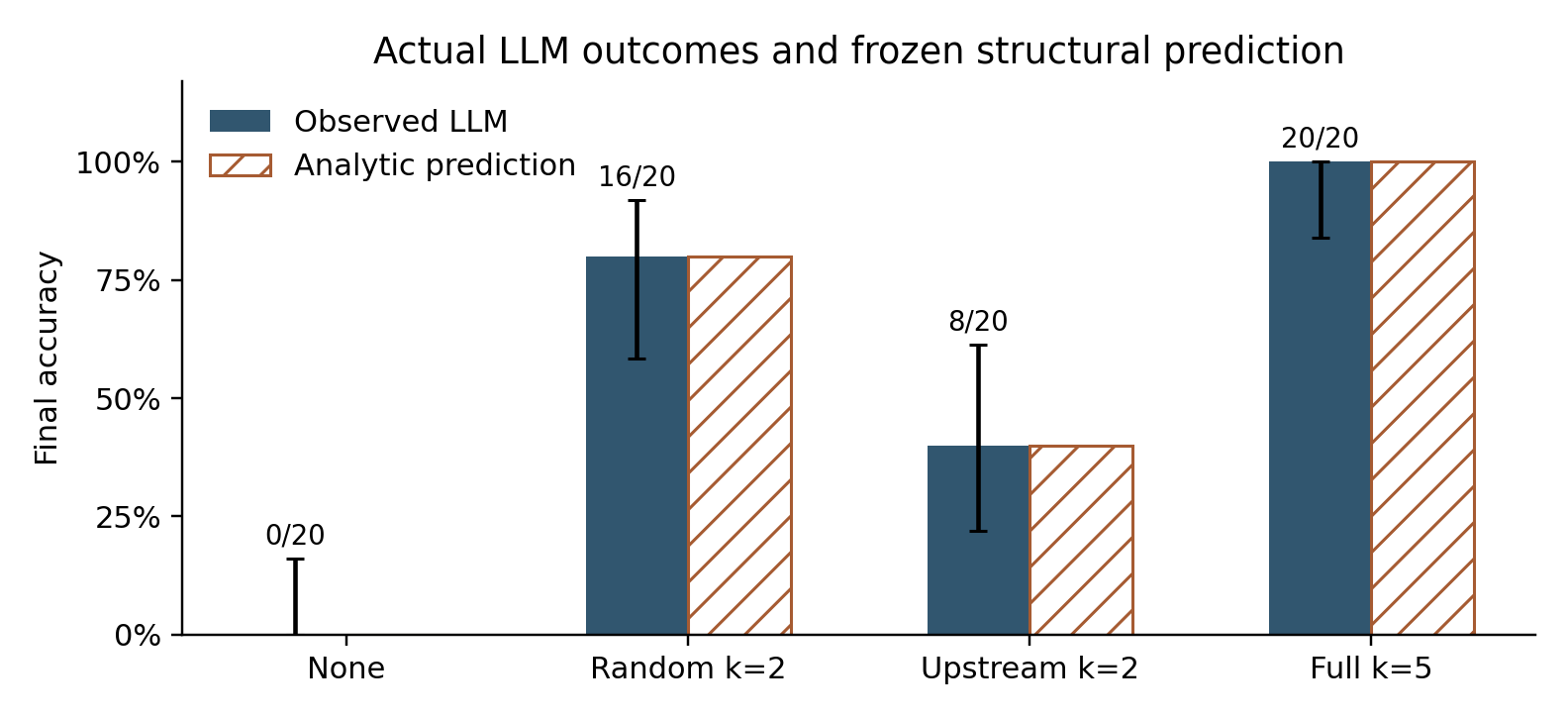
Twenty inventory scenarios went through each of four policies. In every trial, a researcher altered one genuine model handoff. Four scenarios placed the fault at each of the five positions.
The 80 trials used 400 worker responses and 180 verifier responses. A verifier saw the original inventory and every operation up to its stage. Its proposed correction became the value handed on.
| Verification policy | Correct |
|---|---|
| No checks | 0 / 20 |
| Two random positions | 16 / 20 |
| First two positions | 8 / 20 |
| Every position | 20 / 20 |
Interpretation
The information boundary
All 80 final outcomes matched the prediction fixed before the experiment. Every worker’s local arithmetic was correct, even when its starting value had already been altered. A late check could recover the original calculation.
Every main trial contained an injected fault, used the same arithmetic task family and gave verifiers access to the full prefix. The two-check policies used equal numbers of calls. Later checks could consume more tokens. These conditions limit what the comparison can say about other workflows.